
Who’s Afraid of the Big Banned Book?
A student in tears, a book no one should name, and the censorship that leaves no mark on the shelf.
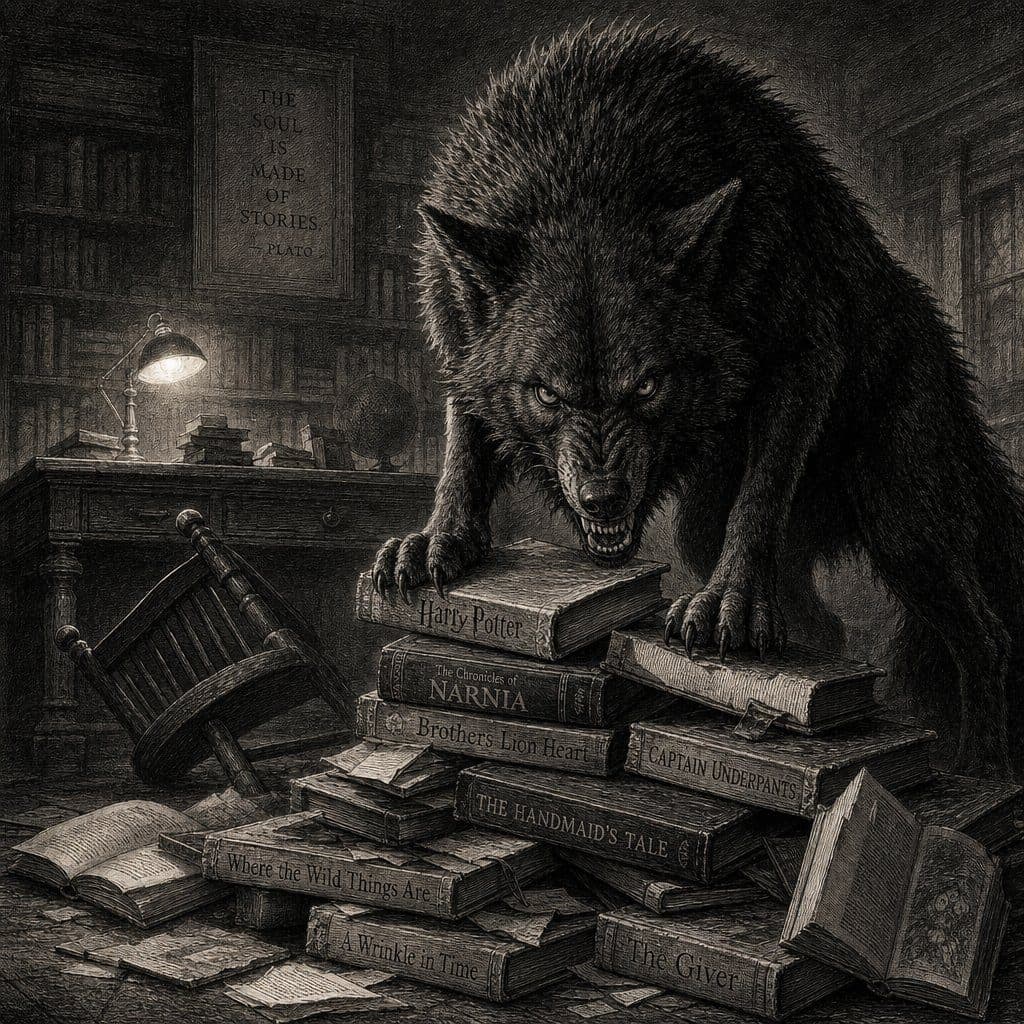
Banned books are bad. Really bad. The end.
Except it isn’t.
It is easy to recognize censorship when someone demands that a book be taken off the shelf. Harder when the book never reaches it. When we decide against buying it because we would rather avoid the conversation—or because our own dislike has quietly become a judgement about what our readers need. We defend our authority to shape a collection. We should. But that authority also asks something of us: the willingness to question our own choices, including the ones that leave no trace on the shelf.
The quieter restriction
Soft banning restricts access without a formal ban. A book may become harder to find or borrow because someone objects to its content. Or it may never be purchased because someone anticipates complaints or wants to avoid a confrontation. This is also described as soft censorship or self-censorship. No announcement. Perhaps no complaint. Just a decision that keeps a book out of reach. And sometimes the restriction falls on the reader.
The book is not the point
A school librarian once contacted me about a student who had been publicly challenged by a member of teaching staff over the book they were carrying. The student had been questioned about where it came from and whether their parents knew they were reading it. The student arrived at the library in tears. An adult had turned a reading choice into a public interrogation. The librarian was furious. I was, too. I raised the incident with school leadership. We needed a conversation with staff about the library, the librarian’s role and young people’s freedom to explore ideas. About their growing ability to decide what they think and who they want to become. And about the privacy of that process. Fortunately, leadership took those concerns seriously, with a firm commitment to the democratic values at stake.
What was the book? It matters not to the point of this story. Naming it would invite us to put the student’s choice on trial all over again. A librarian had exercised professional judgement in making the book available. Yet another adult’s reaction had made borrowing it feel unsafe. No formal ban. No book removed. But what might that student hesitate to borrow next? What might other students learn from watching? Access depends on more than whether a book is on the shelf. It also depends on whether a reader can choose it without being shamed.
Trust goes both ways
Trust your librarian to curate and carefully select books for the students they serve. I could drop the mic there. But if I ask others to respect our professional judgement, I also have to ask how honestly we examine it ourselves. Which books never reach our shelves because we anticipate precisely this kind of confrontation? Sloppy writing. Not relevant. Too expensive. Those can be sound reasons for a decision. They can also be convenient explanations when we dislike a book or would rather avoid an argument.
No library can buy everything. Budgets, space, readers’ needs and the purpose of the collection require choices. A school library also needs careful consideration of developmental suitability.
Passing on a title is not, by itself, evidence of censorship.
The question is whether we apply our criteria consistently. Do we scrutinize a book more harshly because its subject makes us uncomfortable? When we say it is not relevant, whose experience are we using to decide? A book can matter deeply to a student whose life looks nothing like ours. It does not have to be a book we would choose for ourselves. We should be able to explain why we bought a difficult book—and why we passed on it.
The conversation the wolf fears
Librarians and teachers can help young people examine difficult books, question an argument and encounter experiences unlike their own. Reading a book does not require agreeing with it. Carrying one should not require defending yourself in public. Banned Books Week gives us a reason to speak up about the books others want removed. It also gives us a reason to examine our own choices. Are we choosing for our readers, or choosing what is easiest for us to defend?
Ownership of the collection includes responsibility for its absences.
Notes
- Footnote 1.Banned Books Week was launched in 1982 in response to a sudden surge in the number of challenges to books in libraries, bookstores, and schools. Held in the last week of September or first week of October, the annual event highlights the value of free and open access to information and brings together the entire book community — librarians, educators, authors, publishers, booksellers, and readers of all types — in shared support of the freedom to seek and to express ideas. ↩
Filed under
- Field Notes
- banned books
- censorship
- school libraries
- self-censorship
- intellectual freedom
- student privacy
Librarian
A librarian who wrote her dissertation on integrated library systems, and now helps build one. She is making sure the shift to AI is threaded with care, so it works for librarians and the communities they serve, not in place of them.