
Pride & Prejudice
From a Swedish sorority party to armed anime librarians, the many afterlives of the woman in the mousy cardigan.
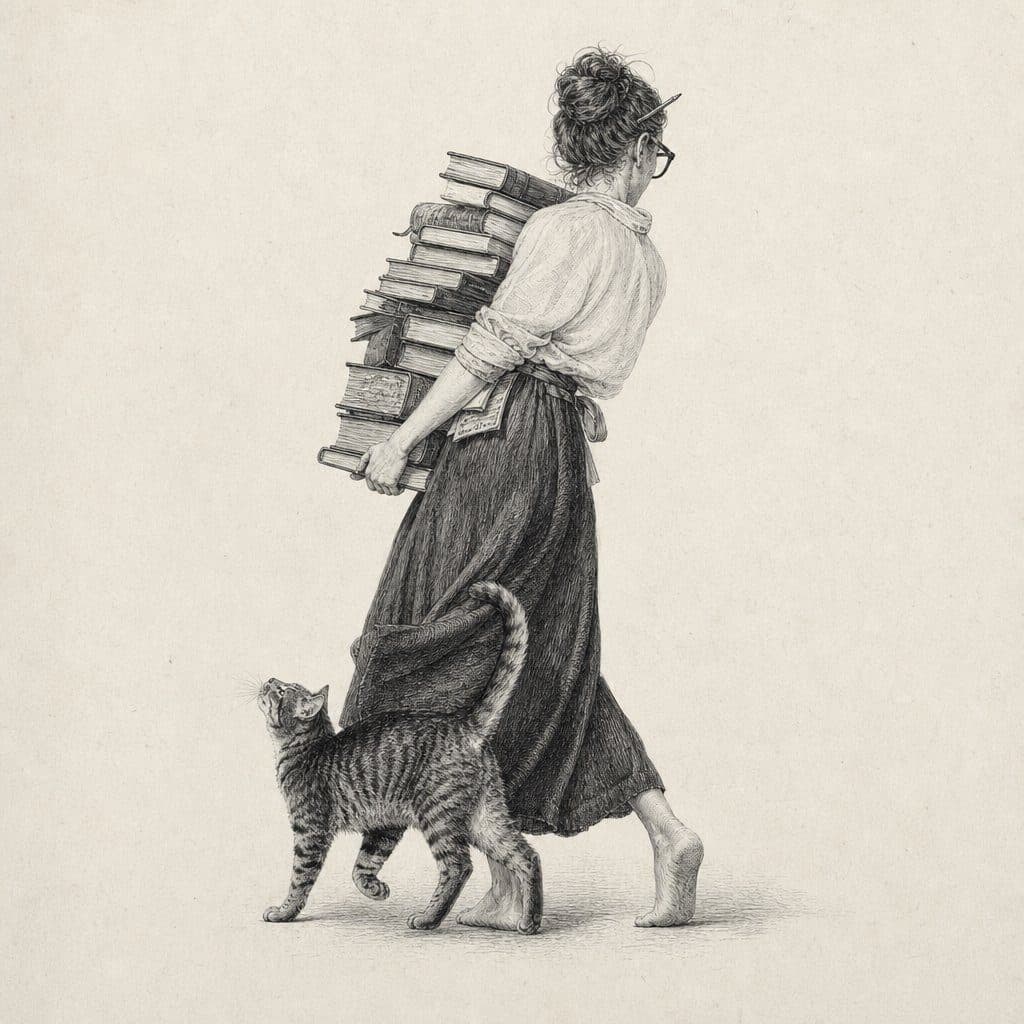
If you close your eyes I bet you can see her. She has a timid air but with a privately judging look, a competent spinster with a mousy coloured cardigan with elbow patches. Above comfortable shoes you can see the tabby hairs on her stockings as the grateful strays keep rubbing when she feeds them on her way to start her shift at the public library.
You think that she has read all of the books in the library and you never hesitate to leave your child with her for a safe afternoon with stories and board games. She's kind, accepts the 24th pub quiz trophy with grace, laughs with a short-nailed hand covering her mouth and those black framed glasses have been mended more times than you can count.
She travels mostly in her head but is secretly saving up for that Writers Retreat in Montana.
If you are one for irony: Dewey — yes, that Dewey, decimal system and all — was asked to step down from the American Library Association in 1905, after four female librarians reported unwanted sexual advances. Maybe we were never quite so "quiet and unassuming" after all. Still waters run deep.
The Erotic Librarian
We were a tight knit group back in librarian school in Borås and we talked a lot about our image — an image so solid, defined and felt as ancient as the profession itself and we were unsure whether we liked that fact or not — if we should lean into it or not. We agreed it WAS funny and to poke fun at ourselves was in our nature and we felt we were so much more than that — young and full of idealism. We were in our student sorority "Klubb Klemming" and we had a yearly party to arrange and we wanted to turn it up a notch.
In the past it had been a slow, cosy "Arwen-event" with lit candles, soft Enya-styled music, dark chocolate and A LOT of cheap red wine but we decided to awaken "The Erotic Librarian" — we leaned in to the aesthetic of high heels, red velvet curtains, short skirts, big eye-glasses and messy buns, indie music and thick, old book props. Quite silly but tongue in cheek and kind of funny too and already the first year it brought down the house — the equally introverted computer engineers joined en masse and it was a great hit! I just found out that it's still running over thirty years later.
The Action Hero(ine)
In Japan, the stereotype went the other direction entirely with Library Wars (Toshokan Sensō) — a massive manga/anime/live-action franchise (roughly ¥1.72 billion box office in Japan) where librarians are armed defenders of intellectual freedom against government censorship — literally "defending the right to read," taken to an action-hero extreme.
The Sisyphean Cat
As a guild we are well aware of the stereotypes and whether you want to run with the concept of the "self-fulfilling prophecy" or the Thomas theorem of "if men define situations as real, they are real in their consequences," it doesn't really matter. It is genuinely hard to get the "cat-hairs" off the stockings, and maybe our energy is better spent defending democracy. I for one believe in change by ownership — lean into it, swallow the sting, be the first one to point it out and manipulate it with humor. Smile and wave.
Notes
- Footnote 1.Not so quiet himself: Twenty years before that ALA resignation, Dewey had insisted women belonged in libraries because they were cheap, eager labor who, in his own reported words, "didn't cause trouble" — valued for compliance, not ambition. Turns out the man who wanted quiet, uncomplaining women in the profession was the one causing all the trouble. ↩
Filed under
- Culture
- librarians
- library stereotypes
- melvil dewey
- library wars
- erotic librarian
- pop culture

Librarian
A librarian who wrote her dissertation on integrated library systems, and now helps build one. She is making sure the shift to AI is threaded with care, so it works for librarians and the communities they serve, not in place of them.